

Understanding the Moro reflex can be quite simple. Think of a baby’s startle response when you put them down too quickly to change their diaper or how some children will cry when they hear a sudden or unexpected sound. You might even see a child blinking or pulling their body away when somebody throws a ball for them to catch. These are all examples of a retained Moro reflex.
The Moro reflex is one of our primary reflexes and the precursor for the startle response/reflex. As a baby cannot protect themselves, they need a way to communicate whenever their body feels in danger. The Moro reflex causes a fight or flight response that is valuable for keeping infants safe. It emerges in utero and ideally integrates by the age of 4 months old.
The Moro reflex is triggered by:
– A loud noise
– A sudden visual stimuli (bright lights)
– An unexpected/sudden backward head movement (the feeling of being dropped)
In response to one of the triggers, the infant throws his/her head back, opens his/her arms/legs, cries, and then pulls in his/her arms/legs.
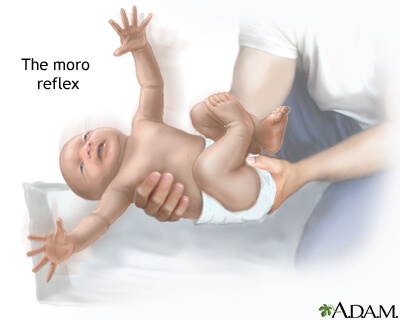
When a child’s Moro reflex is not integrated they may present with one or more of the following challenges:
On a sensory level, a child will often be overly tuned in to what they see, hear and feel. They will struggle to disregard/filter out irrelevant sensory stimuli and subsequently, their bodies are easily overloaded. They can get overwhelmed when exposed to loud sounds, struggle to concentrate when there is background noise, present as being sensitive to invasive touch, or struggle to cope with bright lights or fast-paced visual stimuli to name a few.
In terms of balance and coordination, a retained Moro reflex affects the way in which our bodies make sense of movement input (vestibular). Therefore, it affects the development of our balance, coordination, and general gross motor skills such as ball skills and jumping sequences like skipping.
On an emotional level, a retained Moro reflex will cause a child’s fight or flight response to being overactive resulting in the release of a large number of stress hormones (adrenaline and cortisol). Our bodies are thus prepared to either flee from a potentially harmful situation or stay and fight. In short: the body stays in a state of stress which can lead to several emotional responses (i.e. anxiety, emotional outbursts, poor adaptability, etc.)
On a cognitive level, it is important to remember that a stressed body = a stressed mind. As noted, a retained Moro reflex typically causes a prolonged fight or flight response. When the brain is constantly in “survival” mode, the mind just wants to survive. Important brain functions such as logical reasoning, memory, and problem-solving are pushed aside as survival instincts dominate.
Luckily there are some simple exercises that you can try at home to calm the Moro reflex. If you are however concerned that a retained Moro reflex is impacting your child on a functional level, it is definitely recommended to contact an Occupational Therapist for assistance.
Reflexes are complex but such an important foundation for typical development. We hope that our post is a good starting point to build your understanding of the importance of reflex integration. Please remember that the information provided is not intended to replace any form of therapy. If you have concerns it’s always recommended to seek help from a relevant professional.
Feel free to contact us if you have any additional questions.