
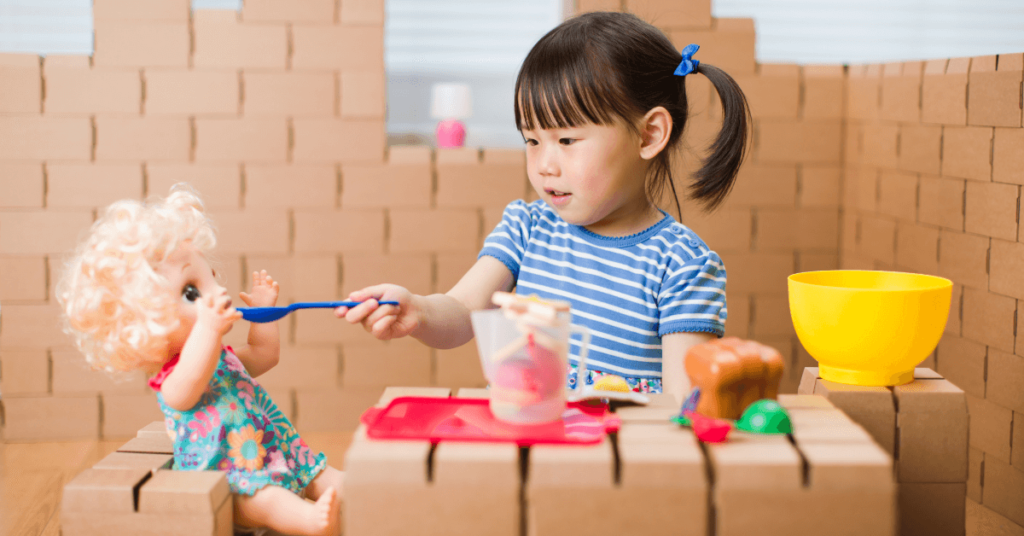
Just the other day I saw a little girl for therapy and upon asking her what game she wants to play, she looked at me blankly and shrugged. “You choose” was all she could get out. I tried to give her options to get her imagination going but she still struggled to figure out how to start painting this metaphorical canvas. Imaginary play, fantasy, creative thinking, invention – call it what you want – children are finding it increasingly difficult to use their imagination.
This got me thinking about a blog post that I wrote during the national lockdown, in the midst of the global coronavirus pandemic. Different years, different circumstances… the same problem… children struggle to play (and I mean REALLY play!).
But why? Why is this a problem? Why are children no longer able to entertain themselves? Why do they constantly seek guidance from whichever parent would give it the quickest?
My opinion … because children are not children anymore!
Strong statement I know! But think about how you played when you were younger. Think about how you kept yourself busy … about your childhood adventures … and then, think about your children. They are brought up in a world that has long forgotten what it means to play. Not sitting in front of a television or playing on a cell phone or tablet. Not even sitting and colouring picture after picture or completing some or other educational book filled with worksheets. I am talking about using your imagination to go on the grandest adventure. Just imagine a mindset like Winnie the Pooh’s:
“Doing nothing often leads to the very best of something”
Winnie the Pooh
The possibilities are endless. Today we can build a princess castle, tomorrow we can go on an adventure under the sea and next week we can become a tiger looking for food in a jungle full of the unexpected.

The reason I am writing this is to spark our imagination again so that we can help our children put back some sense in play. As Albert Einstein said:
“Logic will get you from A to B. Imagination will take you everywhere”
Albert Einstein
Let’s start using what we had to foster childhood memories our children don’t have…
Using one’s imagination and playing creatively is important for all aspects of a child’s growth and development. It not only helps them grow intellectually (cognitively), but also physically, emotionally, and socially.
Let’s use the example of building an imaginary house:
Intellectually: Your child needs to think of what they can use in their environment, work through different steps to get to an end product, problem-solve if some part of their plan is not working, and make decisions on what game they can play once their imaginary house is complete.
Physically: The positive impact on a physical level is endless. Your child will have to use their core and shoulder muscles to move around or manage heavy equipment like blankets and furniture. They might have to carry objects over uneven surfaces or around stationary objects obstructing their way. This can help develop balance reactions, coordination, and control, as well as, an awareness of their body in space. They might even use washing pegs to attach blankets to one another, which develops fine motor skills.
Socially: When your child builds their house with a sibling, friend, or even a parent, they encounter scenarios dependent on the use of basic social skills. Sharing toys, taking turns, making eye contact, and using verbal- (i.e. making requests) or non-verbal (i.e., tone of voice, gestures) cues to convey a certain message. It also teaches them to be respectful, to listen to what others have to say, and teaches them to cooperate and compromise on the ideas they’ve shared. These are all typical challenges that every human being faces, whether at work, at home, or at a social gathering.
Emotionally: Children experience a lot of emotions whilst playing, whether on their own or with their peers. This includes positive and negative emotions (both their own and the emotions of the ones they are playing with). It gives them ample opportunities to learn from the emotional responses of others, as well as, how to regulate their own emotions. They might have to empathize with a crying sibling, learn how to control their own anger if someone does not agree with their plan of how to build the house or forgive a friend for breaking an essential part of their imaginary house. They might even have to learn to stand up for themselves and share their thoughts/ideas, which can help build their self-esteem in the long run.
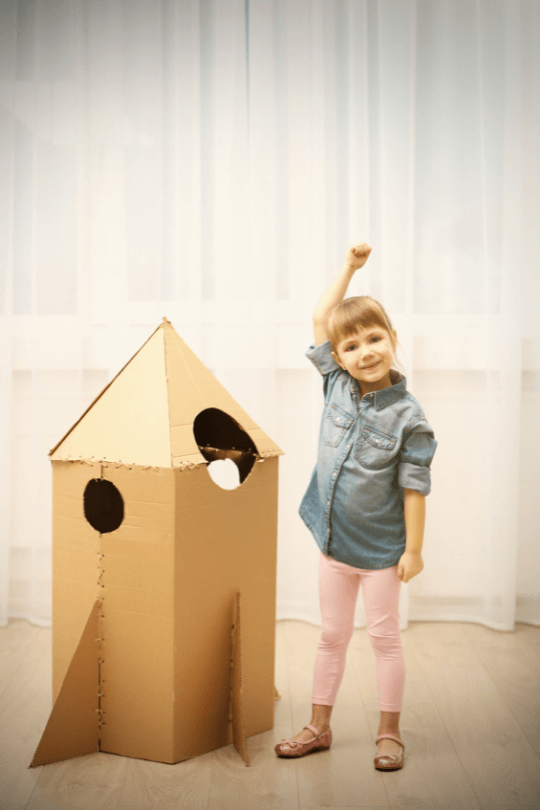
When we allow our children to play like we used to – to imagine, create and experience some of our childhood memories, we help them to develop all these skills that they need in order to turn into independent little human beings. And what’s more – we give them an opportunity to be children again – to make play meaningful and to have a whole lot of fun whilst doing it.
What do I need you might ask? I am going to give you the silliest answer – your IMAGINATION… Just close your eyes and think of holding onto your child’s hand, jumping down the rabbit hole, and experiencing your very own wonderland …
“Actually, the best gift you could have given her, was a LIFETIME of adventures”
Lewis Carroll
Alice in Wonderland
Check out this great post on how to promote imaginary play.
Please feel free to contact us if you have any questions